Build Hack Computer with FPGA

Introduction
In this project we are going to implement the HACK computer designed in parts I and II of the Nand2Tetris course.
Hardware
For the HACK computer itself we will be using a DE10-Lite FPGA board from Terasic. It is available for purchase from their website for around $80 along with many expansion interface, multimedia, video/imaging, networking, AD/DA, robotics boards. It is also freely available on ebay. The board is built around the Altera MAX 10 10M50DAF484C7G chip with 50,000 logic elements, 1,638 Kb of on-chip memory, 64MB of SDRAM, 2x20 GPIO interface and a VGA interface.
Deploying Django web application on AWS EC2 with Ubuntu, nginx, Gunicorn and PostgreSQL

There are many tutorials available online on how to deploy a web application. But If someone asked me to recommend one, I wouldn’t be able to, because I’ve never seen one that I could follow myself to a satisfying result. I would have to piece it together from many separate sources and then probably tweak it for a while until I would get what I want. So I decided to share the steps I went through to deploy my last Django project on AWS. It covers every step from creating an EC2 instance to configuring a wsgi server and reverse proxy, plus a few tips on how to make the deployment more secure.
Studio monitors
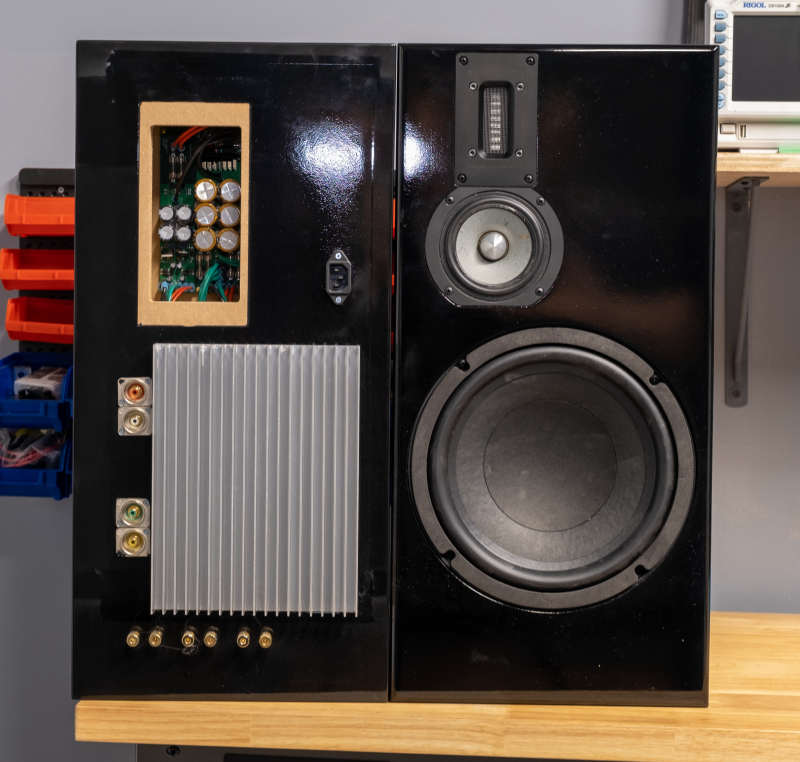
The goal of this project is to build affordable 3-way (extendable to 4-way) speaker system, that can challenge professional studio monitors when in comes to sound quality. There aren’t that many (if any) 3-way active speaker systems readily available to general public, mostly due to the costs of manufacturing process. So historically active speakers have been reserved for commercial use (sound recording studios), while home hi-fi systems were dominated by speakers with passive crossover networks. Even with recent progress in class-D amplifier's sound quality, they are still mostly used in cheaper lower-end bookshelf speakers and sound bars.
Initially I planned to build two speaker enclosures wired for tri-amping and a separate amplifier. But then decided to try and fit the amp inside the enclosure. It required using SMT components to build extremely small 6-channel amplifier with 4-way crossover network and speaker protection circuit. Let’s start with the amplifier topology.
Amplifier design
The power supply is linear. A toroidal transformer with two center tapped secondary windings: 300VA 25V-0-25V and 50VA 15V-0-15V. While this configuration isn’t readily available, you can order it from multiple online stores. The secondaries are fused, just as both outputs. Only the low voltage supply requires stabilization. Both circuits are on the same PCB.
The crossover network is based on 4-th order Linkwitz–Riley topology. It provides 24db/octave roll-of with excellent phase-coherency, resulting in flat summed output at crossover frequency. A bandwidth definition filter removes all the subsonic signals and protects the loudspeakers. It consists of 3-rd order Butterworth highpass with 20Hz cutoff and 2-nd order Butterworth lowpass at 50kHz. The high frequency stage has 6dB gain to make signal less vulnerable to circuit noise. A cascaded 1st-order allpass filter provides a time delay to compensate for the difference in distance between tweeter’s and mid-range speaker’s acoustic centers and listener’s ear. Each output has a voltage divider, which allows to equalize the levels to each speaker’s sensitivity.
Garage gym
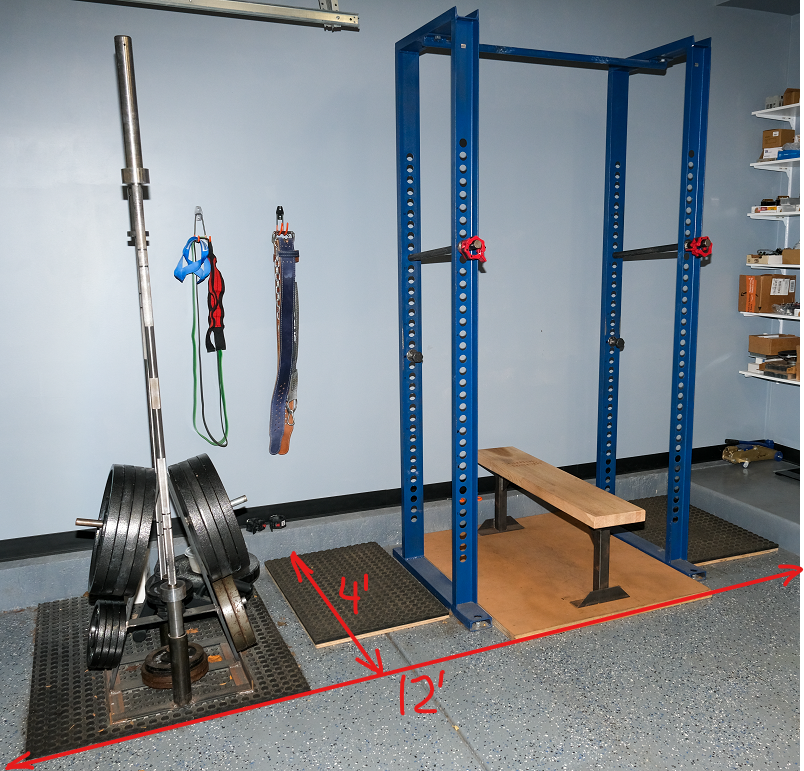
We have to make sure we can use the gym all year around. For many of us it means providing heat in the winter. In my case that also meant insulating the walls. Once I put the insulator and drywall, I decided not to stop there and finish the entire garage. I also decided to coat the floor, since I also planned to use it as my workshop in the future. I went with polyurea for the ease of application and durability.
The next step is heat. After long consideration I decided to go with 5 kW electric heater (FUH54). While it is more expensive than gas, it is much easier and safer to setup it up. All I had to do was run a 1/2" EMT to supply 240V for the heater unit. Of course, you can use 110V if you don't want to do electrical, but you won't be able to get more than 1.5kW out of it, which depending on how harsh the winter is where you live might not be enough. I also installed a separate relay (RC840T-240) connected to an IoT thermostat, so that I could control it remotely.
Quantum mechanics

”If you think you understand quantum mechanics, you don't understand quantum mechanics.”
Richard Feynman
Quantum mechanics – a scientific theory that explains how our world works on a microscopic level. Was born in the beginning of the 20th century, by definition is the antipode of the theory of relativity. Consists of math, cognitive dissonance, holy wars and schrodinger cats, and for that reason is often called “Picasso of physics”. QM is related to processes like superconductivity and superfluidity, practical realization of which will allow in the nearest future building blasters, teleportation, anti-gravity and other cool sci-fi doodads.
Relativity

Relativity – a scientific theory that explains how our world works on a macro-level, combining mechanics, electrodynamics and gravity. Introduced by Albert «E=mc²» Einstein by compiling works of Lorentz, Minkowski, Poincare and his own of course. Divided into two parts: special relativity and general relativity.
History of the subject
At the turn of the 20th century increasing melancholy had been spreading amongst the physicist community. The students were advised by their professors against a career in physics in favor of law, since most of the laws have already been discovered and in 20-30 years, after the last nuances are figured out, there will be nothing left to do. All physics departments will be closed and the faculty given mops to clean the floors in law schools. It is described in Max Planck’s biography.
One of those not yet figured out nuances was how to marry Newton’s mechanics to Maxwell's equations (electrodynamics).